My father has always told me that intelligence and improving ourselves is what makes a human being good, to some extent. That if we just learn the same things, plant the same crops, or even eat the same food, we won’t have much achievement in life. That, if we didn’t advance ourselves in religion, politics, human rights and especially science, we would have been isolated. We would have still been a primate in a tree rather than living on the ground, and using fire to advance ourselves. Is it truly bad to modify food that is, in turn, truly advancing the human civilization, and feeding millions? I believe not. This is why I believe that we are doing more good than harm, and that the reason it isn’t fully gaining potential is through economic and political stances. So I will be talking about the benefits of GMOs that have helped humans by growing crops to resist climate change, can be more advanced in the future, and how it increased yields in multiple countries around the world.
First, GMOs could resist climate change such as drought. In the book Empires of Food, it states “Droughts have always been an existential problem for agricultural societies since they first appeared”pg104. It has ravaged multiple civilizations in the past. History.com states there have been droughts in Ancient Egypt, Africa, MesoAmerica, China, and Syria. Now, CO2 has made climate change so much worse where droughts are more frequent.
There is an organization known as CGIAR that is working on the climate crises, and has even successfully been able to create crops that are resistant to drought. They claim in an article “One way in which they (CGIAR) have responded successfully to the challenge is by developing varieties of major food crops that are drought tolerant or escape drought through early maturity”. Newsweek.com states that Clustered Regularly Interspaced Short Palindromic Repeats or CRISPR has also been try to achieve better crops, as well as many other organizations. In theguardian.com, it states that African countries “saw their yields increase by 20% to 30% after sowing a variety of drought-tolerant hybrids.” Another helper in withstanding droughts would be a corn known as Droughtgard, who in pri.org states “certified for sale in several other countries, including Australia, Canada, Mexico and Japan.”
Another idea on how GMOs can be useful is through its potential . newsweek.com states “food production will have to double by 2050, at which point the world population is expected to have grown from 7 billion today to well beyond 9 billion” With that in mind, people have to realize that GMOs could be an essential factor to life in the next 20 years in the human race. This could also lead to the advancement of GMOs in supply and conditions, or in other words, the second green revolution.
According to the balance.com, “There is no faster way to produce animals and plants with specific beneficial traits and, as we learn more about the genetics, many more modifications will become possible.” With hearing this, we can infer that GMOs are already advancing in agriculture in science right now. grist.org even states that researchers are looking into “This newer system (which)is called C4 photosynthesis. Researchers around the world — funded by nonprofits like the Gates Foundation — are working on creating C4 Rice and C4 Wheat. Those crops could grow 50 percent more food per acre.” Also, in Empire of Food, it talks about how FACE is working and examining rice in order to see if they could could survive higher levels of CO2. The book states that “FACE experiment as the world's most educated guess on how food would grow in the upcoming generations.”pg94 So with that in mind, I believe that GMOs can be able to support in the long run, not only in feeding people but also advancing the science in agriculture as well.
Finally, I want to talk about how GMOs have affected people today, and what are their benefits. Mainly, the biggest one would have to be the yield per acre. Alumni.berkeley.edu states “Bt corn has an estimated yield of 34 percent more in the Philippines, 11 percent in South Africa, 9 percent in Argentina and 5 to 6 percent each in the U.S. and Spain”. Not only that, but ingrist.org states “There are 7 million cotton farmers in India. Several peer reviewed studies have found that, because Bt cotton increases the amount of crop they have to sell, it raises their farm profits by as much as 50 percent, helps lift them out of poverty and reduces their risk of falling into hunger.” GMOs are helping out people by create a higher food supply that has grown both the economy, as well as allowing people to buy affordable food. Also, unlike organic, GMOs grow faster and can be able to stay in a single area without destroying forest. Grist.org states “Either we do this on the same land we have today, or we chop down forest to create farms and pastures to meet that demand, something no one wants to do.”
There are multiple arguments against GMOs, and there are at least two that I have seen.
1.Why are there GMOs when there is also hunger in the world as well? Wasn’t the whole purpose of GMOs as to help stop world hunger?
Well, the reason there still is world hunger even with GMOs is because some countries are anti-GMO, while other times GMOs (like most wonderful things) are used only for profit.
With the expansion of GMOs, there have been multiple countries that have banned GMOs for multiple reason. The main two are that monocultures of GMOs are bad for the environment and that they are “unnatural” or are wrong. Though people could debate about it being wrong to mess with nature, the idea of GMOs being bad for the environment is false. Most of the time, it isn’t GMOs that are ruining nature, but rather the pesticides and herbicides that are being inflicted upon GMOs. In fact, scientist are already creating crops known as Bacillus thuringiensis, or bt crops that don’t need pesticides. Regardless, some countries don’t enjoy crops, and they are paying for it thanks to hunger.
In Zimbabwe, there are laws that restrict the use of GM crops, yet they have experienced multiple droughts. In the circleofblue.org, it states ““Zimbabwe’s restriction on the importation of genetically modified crops, limiting the amount of corn and other grains it can procure from South Africa,” Because of their restriction, Zimbabwe is now facing debt and hunger in their country.
2. Are GMOs healthy for people to eat?
The answer is yes. I have read countless sources, and each one of them said that GMOs are safe to eat. The one problem with GMOs is that there are added pesticides on them. Of course, scientists are working on a crop that is known as Bt crops. They don’t require pesticides because they to be “highly effective at combating pests such as European corn borer, rootworm, corn earworm, tobacco budworm, and bollworm” by harvard.edu. One of the biggest examples would be in grist.org, which states “By reducing the amount of insecticide used (which, in India, is mostly sprayed by hand) Bt cotton has also massively reduced insecticide poisoning to farm workers there — to the tune of 2.4 million cases per year.”
So with all that in mind, I do believe that GMOs aren’t just advancing in agriculture, but also in scientific research. GMOs are advancing the human society in so many ways. With that, I would have to bring back to my father's ideas on always learning, which makes us human. People around the world are dying due to the loss of crops and resources. Children in places such as Zimbabwe are going hungry and dying because of prejudice against GMOs. Even the United Nations, one of the most advanced organizations dedicated to helping countries has even stated “Nearly five million people in Zimbabwe - half of the country's rural population - will need assistance by next year”.
“GMOs have the most potential to advance human society since the development of synthetic nitrogen”
Steve Freeman, Farmer
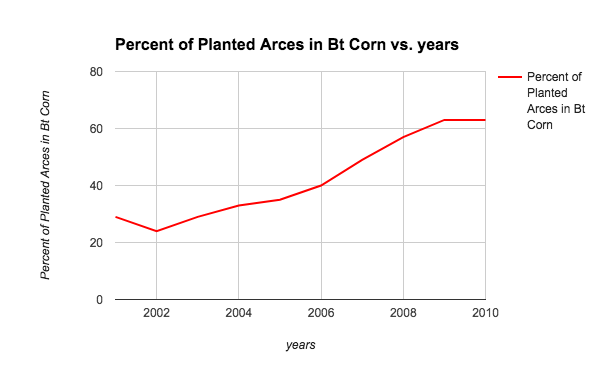
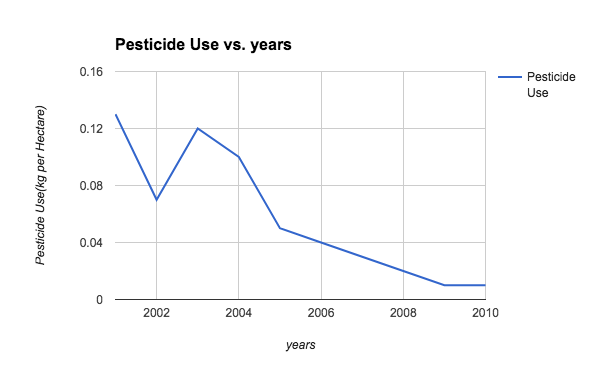
Both these graphs represent the data founded by harvard.edu, and were adapted by Malakof D. and Stokstad E. It shows both the growth of Bt corn and the reduction of pesticides in the US. Since both are related, the two graphs are suggesting that Bt corn are making pesticides more unnecessary.
Pesticide Use vs Years: 2004-2005
0.1 kg = 2004, 0.05 kg=2005
0.05 - 0.1= -0.05/o.1= 50% kilogram decrease in pesticide
Percent of Plant arce in Bt corn: 2006-2007
2006= 40, 2007= 49 49-40=9/40= 22.5% increase of planted acres in Bt corn
Citations
Hsaio Jennifer & Lyon Krissy "GMOs and Pesticides: Helpful or Harmful?" harvard.edu SITN 6/4/1
J. Wechsler "Recent Trends in GE Adoption" usda.gov Economic Research Service 6/4/17
TOM PARRETT "GMO SCIENTISTS COULD SAVE THE WORLD FROM HUNGER, IF WE LET THEM" newsweek.com Newsweek 6/4/17
http://www.newsweek.com/2015/05/29/gmo-scientists-could-save-world-hunger-if-we-let-them-334119.html
Paul Diehl "Can Genetically Modified Food Feed the World" thebalance.com The Balance 6/4/17
Ramez Naam "Why GMOs matter — especially for the developing world" grist.org Grist 6/4/17
Dr. Atli Arnarson "GMO Foods: Good or Bad?" authoritynutrition.com Authority Nutrition 6/4/17
"Genetically Modified Crops" scripts.mit.edu Terrascope 6/4/17
Stacy Finz "GMOs: Research Says They’ll Help End Starvation, but Americans Remain Wary" alumni.berkeley.edu Cal Alumni Association 6/4/17
Jesse Greenspan "7 Withering Droughts" history.com History 6/4/17
"Drought-Tolerant Crops for Drylands" cgiar.org CGIAR 6/4/17
Oliver Balch "Are drought-resistant crops in Africa the tech fix they're cracked up to be?" theguardian.com Guardian US 6/4/17
Matt Weiser "Scientists think GMO crops may help us deal with climate change" pri.org Public Radio International 6/4/17
Matthew Niederhuber & Kaitlyn Choi "Insecticidal Plants: The Tech and Safety of GM Bt Crops" harvard.edu SITN 6/4/17
Evan Fraser &Andrew Rimas "Empires of Food" Counterpoint 4/29/17


